

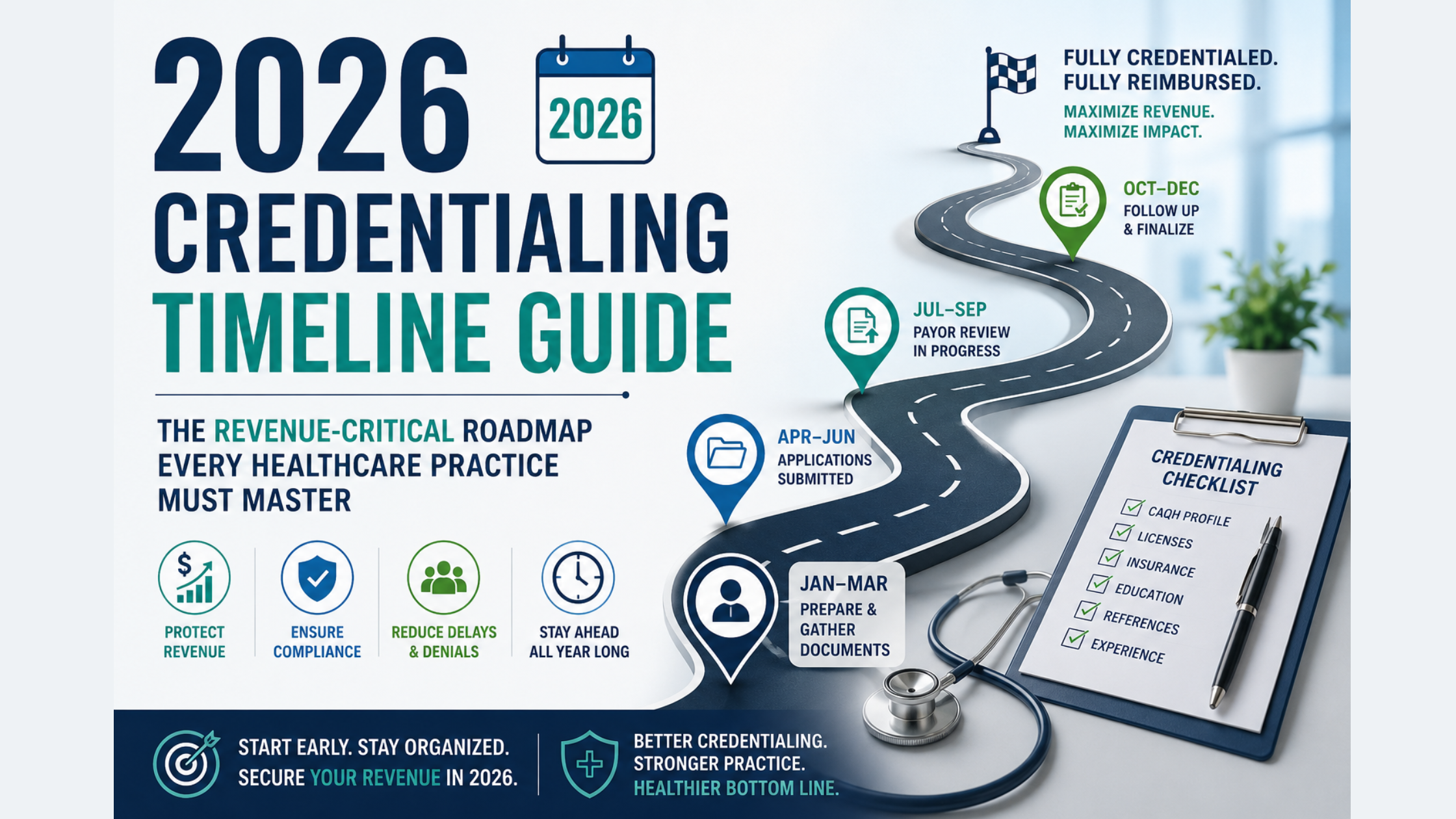
In 2026, provider credentialing has become one of the most financially critical operational processes in healthcare.
Credentialing delays now commonly take between 60 and 180 days, depending on the insurance payer, provider specialty, and state regulations. During this period, healthcare organizations may lose an estimated $7,000 to $12,000 per provider every month because providers cannot legally bill insurance payers until enrollment is finalized.
At the same time, stricter regulatory standards, payer staffing shortages, and tighter verification requirements are creating unprecedented bottlenecks across the healthcare industry.
One major example is the National Committee for Quality Assurance (NCQA), which reduced the allowable Primary Source Verification (PSV) window from 180 days down to 120 days — forcing healthcare organizations to adopt more proactive and structured credentialing systems.
For medical practices, behavioral health clinics, chiropractic offices, therapy organizations, and multi-specialty groups, strategic credentialing management is now directly tied to cash flow, compliance, provider onboarding speed, and long-term growth.
Why Credentialing Matters
More Than Ever in 2026
Credentialing validates a healthcare provider’s:
State licenses
Education and training
DEA registrations
Work history
Board certifications
Malpractice coverage
Sanction screening status
Hospital affiliations
Without completed credentialing and payer enrollment:
❌ Providers cannot bill insurance
❌ Claims may be denied or held
❌ Revenue generation stops
❌ Patient scheduling becomes limited
❌ Compliance risks increase
❌ Practice expansion slows dramatically
Healthcare organizations that fail to plan credentialing early often experience severe revenue interruptions and operational instability.
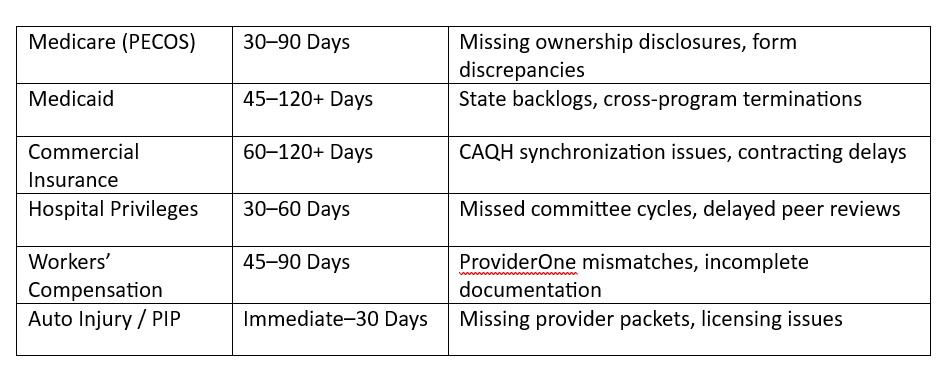
2026 Payer Timeline Expectations
According to the PayerReady Credentialing Team, provider credentialing timelines can vary significantly by payer type, and timelines for Medicare and Medicaid also differ by state.
Standard 2026 Credentialing Forecast
The Complete 2026 Credentialing Timeline Guide
Phase 1: Pre-Boarding & Preparation (Days -120 to -90)
The biggest credentialing mistake practices make is waiting until a provider’s start date to begin enrollment.
Best Practices:
Begin credentialing immediately after the employment offer is accepted
Audit CVs carefully using strict MM/YYYY formatting
Eliminate all unexplained employment gaps
Gather digital copies of:
Diplomas
DEA registrations
State licenses
Malpractice insurance certificates
Board certifications
Verify that identifiers match exactly across:
NPPES
PECOS
CAQH
Tax ID records
Common 2026 Credentialing Failure:
Even minor inconsistencies in legal names, addresses, or TIN records can trigger automatic payer rejections.
Phase 2: System Setup & Submission (Days -90 to -60)
During this stage, practices establish the provider inside national enrollment systems and submit initial payer applications.
Critical Tasks:
Complete CAQH ProView profiles thoroughly
Authorize target insurance payers
Re-attest CAQH every 120 days
Submit Medicare applications through PECOS
Pay the mandatory state processing fee for 2026
Upload EFT and W-9 documentation
Important 2026 Update:
Many payers now require digital identity verification and enhanced ownership disclosures before applications move forward.
Medicaid Application Fees:
Several states implemented increased institutional processing fees in 2026, including Medicaid application fees approaching $750 in some regions.
Phase 3: Primary Source Verification & Payer Review
(Days -60 to -30)
This phase typically becomes the largest bottleneck in the credentialing cycle.
Key Activities:
Medical schools validate education
Residency programs verify training
Previous employers confirm work history
Licensing boards conduct PSV checks
Payers perform sanctions screenings
Best Operational Strategy:
Follow up with payers every 7–10 days
Respond to requests within 24–48 hours
Maintain centralized tracking dashboards
Monitor application queue movement continuously
Critical NCQA Rule Change:
The Primary Source Verification window has shortened from 180 days to 120 days, increasing the urgency of rapid document collection and submission.
Phase 4: Final Contracting & Go-Live Activation (Days -30 to Day 1)
Once approved, practices must finalize payer participation and operational activation.
Final Tasks:
Check schedules carefully to ensure providers are only available after credentialing is fully complete.
Confirm participation in the provider network.
Verify the official billing effective dates.
Update EHR and practice management systems accordingly.
Train front-office staff.
Activate scheduling workflows.
Important Warning:
Scheduling patients before the official effective date may result in non-payable claims.
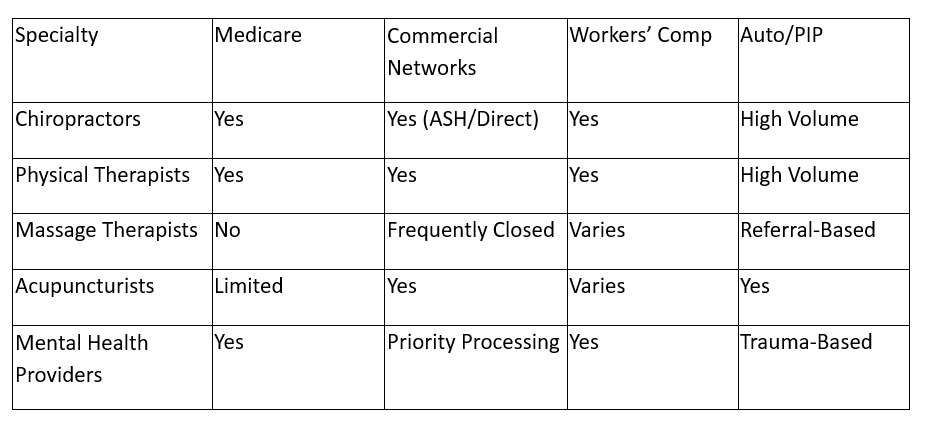
Specialty-Specific Credentialing Challenges in 2026
Different provider specialties now face dramatically different payer enrollment realities.
Massage Therapists (LMTs)
According to a report from Med Cloud MD, in 2026, massage therapists, like other providers, must contend with increasingly strict verification rules from commercial payers, which can lead to lengthy credentialing processes if any documentation is missing.
Common Challenges:
Closed network panels
Geographic restrictions
Letter of Intent (LOI) requirements
Limited direct commercial participation
Some commercial networks require proof of regional provider shortages before applications are even accepted.
Chiropractors & Acupuncturists
Many chiropractic and acupuncture providers are credentialed through third-party management organizations such as:
American Specialty Health (ASH)
Optum specialty networks
This creates additional administrative layers and altered processing timelines.
Medicare Limitation:
Chiropractors enrolled in Medicare remain restricted primarily to manual spinal manipulation billing.
Behavioral Health Providers
Behavioral health providers continue receiving priority credentialing processing due to national shortages.
Fast-Track Areas Include:
Mental health counseling
Substance use disorder treatment
Trauma therapy
Behavioral analysis services
However, specialized credentialing standards still apply for:
BCBAs
Psychologists
Psychiatric nurse practitioners
Specialty Credentialing Matrix
Critical 2026 Submission Rules
1. Washington L&I & ProviderOne Alignment
Practices billing Washington Labor & Industries claims must synchronize:
ProviderOne profiles
OFM Vendor/Payee forms
Provider Account Applications
Failure to map payee IDs correctly can instantly halt electronic payment processing.
2. Auto Injury & PIP Credentialing
Many auto injury payers such as:
State Farm
Geico
PEMCO
National General
do not require traditional contracted credentialing for out-of-network billing.
However, practices must submit:
W-9 forms
Active licenses
NPI documentation
Physical location verification
with initial claims to prevent rejection.
3. Strict CV Formatting Standards
Commercial payers increasingly reject applications with:
Incorrect MM/YYYY formatting
Employment gaps over 6 months
Missing written explanations
Premera Blue Cross and other major networks have intensified application audits in 2026.
How Availity Is Transforming
Credentialing Operations in 2026
Availity Essentials has become a significant platform for streamlining payer credentialing workflows in 2026. According to Availity, consolidating responses through a centralized portal like Essentials can reduce operational fragmentation and improve credentialing efficiency.
Step-by-Step Availity Tracking Workflow
1. Payer Enrollment Tracking (Aetna & UHC)
Inside Availity:
Navigate to Provider Engagement
Open Payer Enrollment
Select the provider TIN and state
Practices can monitor real-time status updates including:
Received
In Review
Contracting
Active
This eliminates unnecessary payer call center delays.
2. Payer Spaces for Premera & Regence
Pacific Northwest payers heavily rely on Availity Payer Spaces.
Benefits:
Application tracking
Closed panel alerts
Missing documentation notices
Dynamic enrollment notifications
Many providers discover panel closures weeks earlier through Availity than through mailed notices.
3. Secure Messaging for Credentialing Escalations
When status tools are unavailable:
Use Secure Messaging
Upload original submission receipts
Include provider NPI information
This routes requests directly to credentialing departments instead of general support queues.
Critical Availity Configuration Actions for 2026
Link CAQH Accounts
Ensure organizational CAQH accounts sync with Availity permissions.
Enable Enrollment Notifications
Activate alerts for:
Status changes
Missing documents
Addendum requests
Approval updates
Upload Addendums Directly Through Availity
Never fax requested updates.
Uploading directly preserves the original submission timestamp and prevents the application clock from restarting.
Biggest Credentialing Risks in 2026
Payer Staffing Shortages
Insurance organizations continue experiencing staffing shortages and operational backlogs.
Verification Delays
Responses to PSV requests from third-party institutions can often take several weeks, causing significant credentialing delays.
Recredentialing Oversights
Missing renewal deadlines can immediately interrupt billing privileges.
Multi-State Compliance Complexity
Telehealth expansion continues increasing cross-state licensing challenges.
Best Practices to Accelerate Credentialing
✅ Start credentialing 90–120 days before provider onboarding
✅ Maintain perfect CAQH accuracy
✅ Centralize credential tracking systems
✅ Monitor expiration dates automatically
✅ Conduct weekly payer follow-ups
✅ Use digital credentialing dashboards
✅ Respond to payer requests within 24 hours
✅ Track every application milestone in real time
Final Thoughts
In 2026, credentialing is no longer just an administrative checkbox — it is a core revenue protection strategy.
Healthcare organizations that proactively manage:
payer enrollment,
CAQH accuracy,
Availity tracking,
compliance monitoring,
and specialty-specific workflows
will dramatically outperform organizations relying on outdated manual systems.
Practices that build efficient credentialing infrastructures today will reduce delays, accelerate cash flow, improve compliance, and create a stronger operational foundation for long-term healthcare growth.