Credentialing Done? Don’t Celebrate Yet.
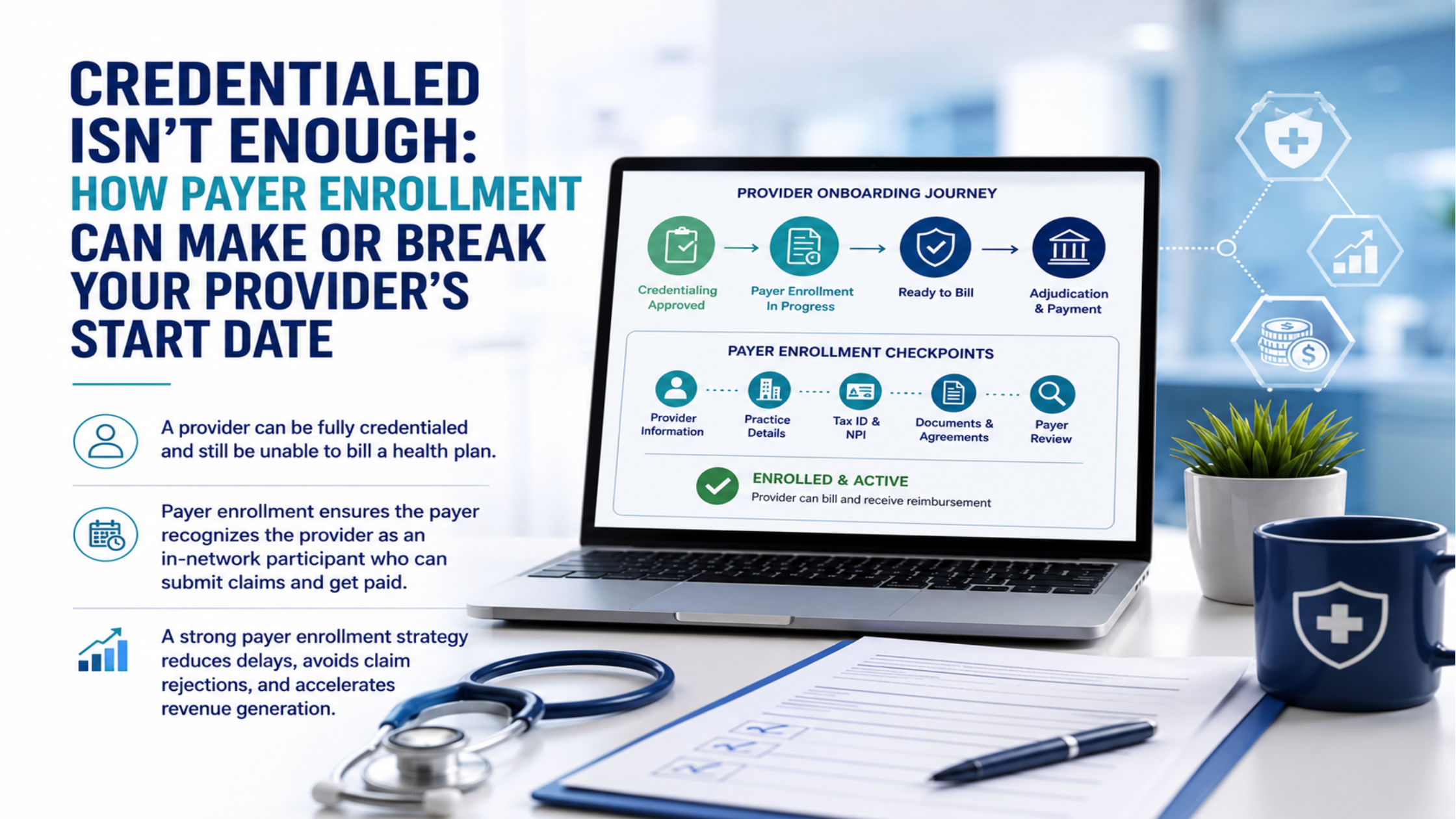
A provider can be fully credentialed and still be unable to bill a health plan.
That’s one of the most frustrating realities in healthcare administration.
Many organizations focus heavily on provider credentialing—verifying licenses, education, work history, malpractice coverage, sanctions, and other qualifications. But there’s another critical step that often determines whether a provider can actually participate in a health plan and receive reimbursement:
Payer enrollment.
Think of credentialing as proving that a provider is qualified to practice.
Payer enrollment is making sure the payer recognizes that provider as an in-network participant who can submit claims and get paid.
When these processes aren’t coordinated, organizations can face delayed provider start dates, claim rejections, lost revenue, and unnecessary administrative work.
The good news?
A well-designed payer enrollment strategy can significantly reduce the time between credentialing completion and revenue generation.
What Is Payer Enrollment?
Payer enrollment involves signing up a healthcare provider with insurance carriers and other payers so the provider can participate in their networks and receive reimbursement for covered services.
Depending on the payer and provider type, enrollment may involve submitting:
Provider demographic information
NPI information
Tax identification details
Licenses and certifications
CAQH information
Practice locations
Taxonomy codes
EFT and ERA information
Malpractice insurance
W-9 documentation
Ownership information
Payer-specific forms and agreements
The payer then reviews the application, verifies the information, and determines whether the provider can be enrolled.
This sounds straightforward.
In reality, payer enrollment can become one of the biggest bottlenecks in the provider onboarding process.
Credentialing vs. Payer Enrollment:
What’s the Difference?
The terms are often used interchangeably, but they are not the same.
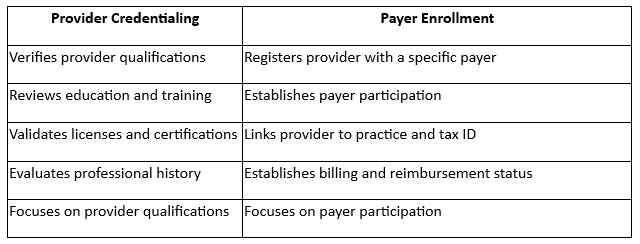
Here’s the easiest way to think about it:
Credentialing asks:
“Is this provider qualified?”
Payer enrollment asks:
“Can this qualified provider participate in our network and bill us?”
Both are essential.
And treating them as completely separate workflows can create unnecessary delays.
Why Payer Enrollment Can Slow Down
Provider Onboarding
Imagine this:
A physician is hired today.
Their credentials are collected and submitted. The credentialing process moves forward. The provider eventually receives credentialing approval.
The practice assumes the physician is ready to see patients.
But there’s a problem.
The provider hasn’t been fully enrolled with several major payers.
The physician can see patients—but claims may not process as expected.
Now the practice has to scramble to determine:
Which payers are pending?
Which applications were submitted?
Which documents are missing?
Has the payer approved the provider?
Is the effective date active?
Is the provider linked to the correct tax ID?
Is the practice location correct?
Is the provider properly loaded into the payer’s system?
What looked like a successful credentialing process suddenly becomes a revenue-cycle problem.
The Hidden Cost of Delayed Payer Enrollment
A delayed enrollment isn’t just an administrative inconvenience.
It can have a direct financial impact.
1. Delayed Revenue
If a provider cannot properly bill a payer, reimbursement may be delayed or claims may be denied.
For high-volume specialties, even a short delay can translate into significant lost or delayed revenue.
2. Claim Rejections
Incorrect payer enrollment data can contribute to problems involving:
Provider identifiers
Tax IDs
NPIs
Billing locations
Network status
Effective dates
These issues can create avoidable claim rework.
3. Slower Provider Start Dates
Organizations may recruit a provider months before the provider is expected to begin seeing patients.
If enrollment isn’t started early enough, administrative delays can interfere with the planned launch.
4. More Administrative Work
Every unresolved enrollment issue can trigger another email, phone call, portal submission, follow-up, or status check.
Multiply that across dozens or hundreds of providers and payers, and the workload quickly becomes substantial.
How Payer Enrollment Can Actually
Speed Up Credentialing
The secret isn’t simply “submit enrollment applications faster.”
The real advantage comes from coordinating credentialing and enrollment as connected workflows.
Here are five strategies that can make a major difference.
1. Start Payer Enrollment Early
One of the biggest mistakes organizations make is waiting until credentialing is complete before thinking seriously about enrollment.
Instead, identify payer requirements early.
As soon as a provider is being onboarded, determine:
Which payers are relevant?
Which payer networks does the practice participate in?
What documentation will each payer require?
Does the payer require credentialing approval first?
What information needs to be consistent across applications?
Are there payer-specific enrollment requirements?
Starting early gives your team more time to address missing information before the provider’s planned start date.
2. Keep Provider Data Consistent
One incorrect field can create unnecessary delays.
For example, a provider’s:
Name
NPI
Taxonomy
Practice address
Tax ID
License information
CAQH profile
must be accurate and consistent.
A mismatch between credentialing records and payer enrollment applications can trigger additional verification or requests for correction.
The solution?
Establish a centralized, reliable database for all provider information.
Instead of repeatedly entering information into different systems, organizations can maintain standardized provider profiles and use them to support credentialing, enrollment, contracting, and billing workflows.
3. Treat CAQH as a Critical Data Source
For many healthcare providers, the CAQH Provider Data Portal plays an important role in credentialing and payer enrollment.
Keeping the provider’s CAQH profile accurate and current can help reduce data discrepancies.
Common issues include:
Expired licenses
Outdated addresses
Missing malpractice information
Incomplete work history
Incorrect practice affiliations
Outdated contact information
A strong process includes regular monitoring and timely updates.
The goal isn’t simply to complete a CAQH profile. It’s to keep the underlying provider data accurate throughout the provider’s lifecycle.
4. Build a Payer-Specific Enrollment Checklist
There is no universal payer enrollment process.
Different payers can have different requirements, forms, portals, contracts, processing workflows, and documentation standards.
That’s why a generic checklist isn’t always enough.
Create payer-specific workflows covering:
Application requirements
Required documentation
Submission method
Contact information
Application status
Follow-up schedule
Effective date
Approval confirmation
Billing-system setup
Revalidation requirements
This turns enrollment from an informal administrative task into a repeatable operational process.
5. Track Enrollment Status From Submission to Activation
Submitting an application is not the finish line.
It’s the beginning of the tracking process.
A strong enrollment dashboard should allow your team to see:
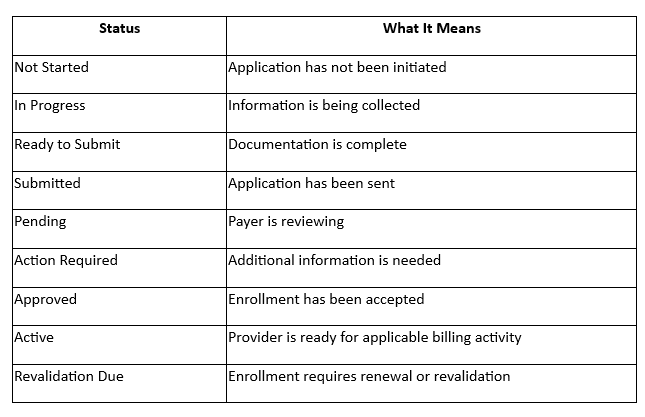
This visibility helps prevent applications from disappearing into a spreadsheet or inbox.
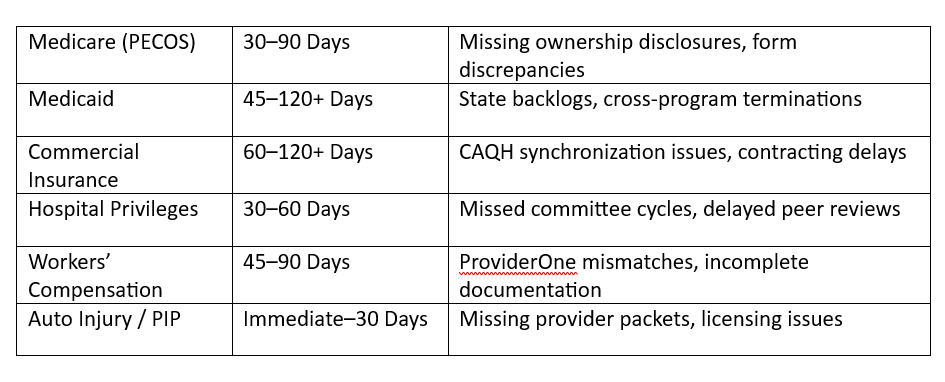
The Payer Enrollment Timeline:
What Can Cause Delays?
Enrollment timelines vary significantly depending on the payer, provider type, application completeness, and other factors.
Common causes of delays include:
Incomplete Applications
Missing documentation can force the payer to request additional information.
Data Mismatches
Differences between submitted information and payer records can lead to additional review.
Expired Credentials
An expired license, certification, or malpractice policy can hold up processing.
Incorrect Practice Information
A provider may be associated with the wrong location, tax ID, or group.
Poor Follow-Up
Applications can remain pending longer when organizations don’t have a structured follow-up process.
Payer-Specific Requirements
A process that works for one payer may not work for another.
The takeaway is simple:
Enrollment speed is often determined before the application is even submitted.
Better preparation creates fewer opportunities for delays.
A Faster Provider Onboarding Workflow
Instead of treating credentialing and payer enrollment as separate administrative projects, consider an integrated workflow:
Provider Hired
↓
Collect Provider Information
↓
Verify Credentials
↓
Complete/Update CAQH
↓
Identify Target Payers
↓
Prepare Payer Applications
↓
Submit Enrollment Applications
↓
Track Payer Responses
↓
Resolve Missing Information
↓
Confirm Approval & Effective Date
↓
Update Billing/Practice Systems
↓
Provider Ready for In-Network Billing
This approach creates visibility across the entire provider onboarding lifecycle.
How Technology Can Improve Payer Enrollment
Manual enrollment processes can become difficult to manage as an organization grows.
Spreadsheets, email threads, shared folders, and disconnected payer portals can make it challenging to answer basic questions:
What has been submitted?
What’s still pending?
Who needs to follow up?
Which providers are ready to bill?
Technology can help by centralizing information and automating parts of the workflow.
Useful capabilities may include:
Automated task reminders
Centralized provider profiles
Document management
Application status tracking
Expiration alerts
Payer-specific workflows
Reporting dashboards
Audit trails
Enrollment milestone tracking
The objective isn’t to eliminate human oversight.
It’s to eliminate unnecessary administrative friction.
The ROI of Getting Payer Enrollment Right
The value of faster enrollment goes beyond saving administrative hours.
A more efficient enrollment process can help organizations:
Reduce Revenue Delays
Providers can move toward billable activity sooner when payer requirements are addressed proactively.
Reduce Rework
Accurate provider data reduces repetitive corrections and follow-up.
Improve Staff Productivity
Enrollment teams spend less time searching for information and more time resolving actual issues.
Improve Provider Experience
New providers don’t have to wait unnecessarily because administrative processes weren’t coordinated.
Improve Revenue Cycle Performance
Accurate enrollment information supports cleaner downstream billing operations.
The Biggest Mistake? Treating Enrollment
as an Afterthought.
Provider credentialing doesn’t automatically mean a provider is ready to generate revenue.
That’s why healthcare organizations should think beyond:
“Is the provider credentialed?”
The better question is:
“Is the provider fully prepared to participate, bill,
and receive reimbursement from the payers
that matter to our organization?”
That shift in perspective can transform provider onboarding.
Your Payer Enrollment Checklist
Before declaring a provider “ready,” verify:
☐ Provider information is accurate
☐ NPI is correct
☐ Taxonomy is correct
☐ Licenses are current
☐ CAQH information is complete and current
☐ Practice locations are accurate
☐ Tax ID/group information is correct
☐ Required payer applications are submitted
☐ Missing information requests are resolved
☐ Payer approval has been confirmed
☐ Effective dates have been verified
☐ Billing systems reflect the correct provider/payer configuration
☐ Enrollment and revalidation deadlines are being tracked
This simple checklist can help identify gaps before they become revenue-cycle problems.
Final Takeaway: Credentialing Gets You Qualified. Enrollment Gets You Ready to Bill.
Payer enrollment is one of the most important—and frequently underestimated—components of provider onboarding.
A provider can be highly qualified, fully credentialed, and ready to practice, yet still face billing obstacles if payer enrollment isn’t completed correctly.
The fastest organizations don’t wait for problems to appear.
They:
Start early
Standardize provider data
Coordinate credentialing and enrollment
Monitor payer-specific requirements
Track applications through completion
Verify effective dates
Maintain accurate records
Use technology to reduce manual work
Ultimately, faster payer enrollment means a faster path from provider hire to operational readiness and revenue generation.
And in healthcare, where administrative delays can quickly become financial delays, that’s not just a credentialing advantage.
It’s a business advantage.
Frequently Asked Questions
About Payer Enrollment
What is payer enrollment?
Payer enrollment means signing up a healthcare provider with an insurance company, enabling the provider to join the payer’s network and receive payment for eligible services.
Is payer enrollment the same as credentialing?
No. Credentialing generally focuses on verifying a provider’s qualifications, while payer enrollment establishes the provider’s participation with a specific health plan or payer.
Why is payer enrollment important?
Without appropriate payer enrollment, a provider may not be able to properly participate in a payer network or receive reimbursement for services, even after completing credentialing.
When should payer enrollment begin?
Organizations should evaluate payer enrollment requirements as early as possible during provider onboarding rather than waiting until all credentialing activities are finished.
How can organizations speed up payer enrollment?
Organizations can improve enrollment speed by maintaining accurate provider data, keeping CAQH information current, using payer-specific checklists, submitting complete applications, tracking application status, and following up systematically.
What causes payer enrollment delays?
Common causes include incomplete applications, inaccurate provider information, missing documentation, expired credentials, data mismatches, payer-specific requirements, and insufficient follow-up.
Conclusion
Provider credentialing and payer enrollment should never operate in isolation.
When these workflows are aligned from the beginning, healthcare organizations can reduce administrative bottlenecks, improve provider onboarding, minimize avoidable billing issues, and create a smoother path to reimbursement.
The real goal isn’t simply to credential providers faster.
It’s to get qualified providers fully enrolled, operational, and ready to bill—without unnecessary delays.